
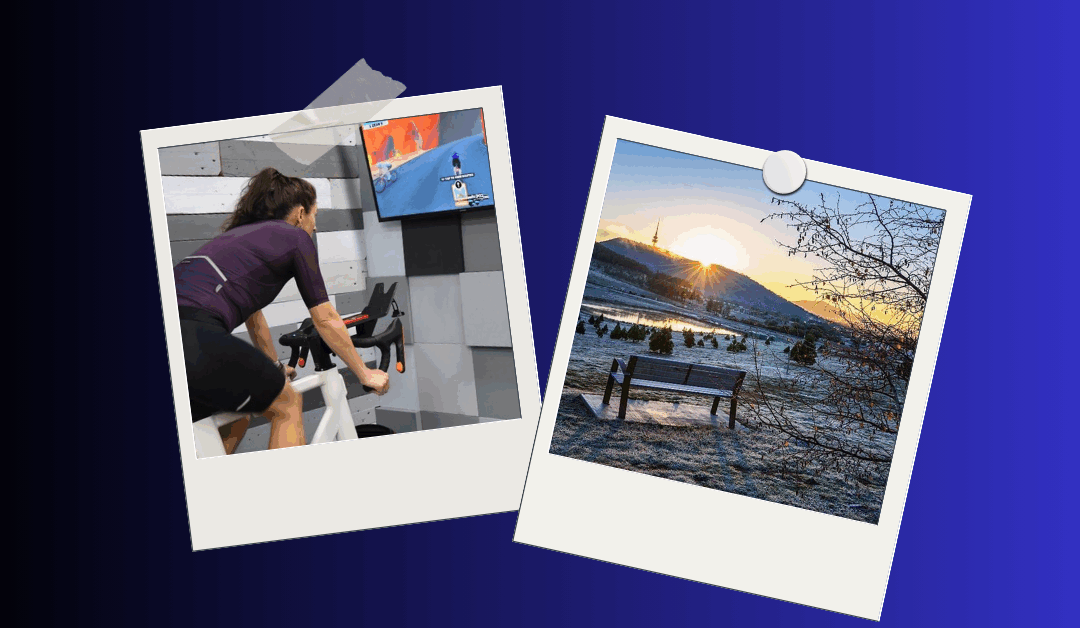
Welcome back to Ride, Tri and Thrive! Over the last two editions, we’ve explored how to navigate setbacks and disappointment, how to recover from illness quickly, and how to stay motivated through winter with articles such as ‘This Season, Train for Fun,’ ‘Stay Fit in Winter,’ and ‘Winter Cycling in Canberra.’ Today, we continue that journey by tackling one of winter’s biggest training questions: the winter dilemma of indoor or outdoor training — a decision every athlete faces as they navigate winter fitness.
The Winter Dilemma: Do I Brave the Cold or Stay Inside?
Let’s be honest: winter in Canberra can test even the most committed among us. I know, because I’m right there with you.
Some days, I’m out on the trails at Bruce Ridge or sneaking in a lunchtime ride or run when work allows. On other days, I’m riding with mates under the lights on a crisp night MTB session (don’t knock it until you try it, by the way – it’s a great way to explore your favourite trails differently). But then there are mornings where my alarm goes off, the frost glistens on the lawn, and even with my years of experience, my brain says: “Nope, not today.” And that’s exactly when my indoor trainer becomes my best training partner.
We’ve discussed how layering up correctly makes outdoor rides possible and how adjusting our mindset keeps us motivated throughout these months. But even so, there are days when it’s simply better — and smarter — to stay inside.
If you’re feeling that stress too, you’re not alone. The good news? Both options serve a valuable purpose, and science supports this.
The Science: Indoor Training – Precision & Control
Indoor training offers unmatched control. There’s no traffic, no sudden weather changes, no kangaroos jumping across the path (yes, it’s happened!). You can execute precise intervals with consistent power, heart rate, speed and cadence.
Multiple studies, including those by Chavarrias et al. (2019), have shown that indoor training can match or even exceed outdoor sessions in terms of physiological adaptations, primarily because it allows you to reach your training zones without external disruptions. Structured indoor sessions are ideal for high-intensity work, including sweet spot, threshold, and VO2 max sessions, which can help you become fitter and faster.
But while efficient, indoor training isn’t perfect. It lacks the real-world skills of handling, balance, and terrain variation. And psychologically, it can sometimes feel monotonous — the phenomenon of “Zwift fatigue“ is a real occurrence.
The Science: Outdoor Training – Skill & Mental Resilience
Outdoor training, on the other hand, challenges more than just your physiology. You’re constantly engaging your neuromuscular system: steering, reacting, cornering, descending, and foot placement. These real-world demands help develop essential technical proficiency, especially when preparing for races or events (Bicycling, 2022).
There’s also the emotional side. Exposure to natural light helps regulate mood and sleep (Czeisler & Gooley, 2007), supports vitamin D levels for immune health, and contributes to our overall sense of well-being. Those winter lunchtime rides? They do wonders for clearing the mind and breaking up long workdays.
But outdoor riding isn’t always practical or safe. Canberra’s icy mornings, rain, wind, short daylight, or black ice can make it risky, especially if you’re fatigued.
It’s Not Either/Or — It’s About Blending Intelligently
This is where I step in as a coach to guide you through these choices and help you make decisions that feel right for you. Many have heard me say this before: performance isn’t about doing everything perfectly. It’s about making intentional, informed decisions that align with your goals, life, and energy.
Sometimes, you might schedule more indoor sessions because life is busy, or you don’t want to fight the elements. Other weeks, you take the opportunity to get outside for a skills ride, a run along the lake, or a night MTB adventure with friends.
And let’s not forget swimming — another winter challenge for many triathletes. While the heated pool offers consistency, winter can still test motivation to get there. Indoor swim sessions are ideal for technique work, controlled pacing, and strength development, as they eliminate the challenges of battling open water elements. And when possible, open water swims — even occasional ones — keep sighting and water confidence sharp. Again, it’s about blending what works for your season and goals.
Consistency matters more than the platform. As long as you’re training with purpose, you’re progressing.
Avoiding the Overload Trap
One thing I’ve noticed more than ever: there’s an overwhelming amount of advice out there. Zwift plans, YouTube experts, podcasts, and social media influencers all shout: “This is the best way to train!”
This is where many people get stuck.
My role as a coach is to cut through that noise. I help you understand what works best for you — your physiology, schedule, mindset, and goals. When you’re balancing training with work, family, and a Canberra winter, having clarity matters more than perfection.
If you’re finding yourself second-guessing your plan or drowning in information, coaching brings simplicity, structure, and accountability. And most importantly, it keeps the fun and purpose alive — even when it’s minus 2 outside!
A Winter Mindset to Thrive
So as you navigate the next few months, remember:
- Use indoor sessions for efficient, high-quality work.
- Use outdoor sessions for skill development, enjoyment, and mental rejuvenation.
- Give yourself permission to adapt based on the weather, your mood, and your goals.
- And never underestimate the power of having a coach in your corner to guide you.
You’ve got this.
Thank you for being part of the Ride, Tri, and Thrive community! I’m here to support your journey and would love to hear how you’re thriving this season. Visit coachhulskamp.com.au for more insights, resources, and personalised coaching to keep you thriving. Let’s ride, tri, and thrive together!
References:
- Chavarrias, M. et al. (2019). “Cycling training adaptations with indoor vs. outdoor training.” Journal of Strength and Conditioning Research, 33(11), 3032-3040.
- Stöggl, T., & Sperlich, B. (2014). “Polarized training has greater impact on key endurance variables than threshold, high intensity, or high volume training.” Frontiers in Physiology.
- Bicycling Editors. (2022). “How Outdoor Cycling Improves Your Skills.” Bicycling.com.
- Czeisler, C. A., & Gooley, J. J. (2007). “Sleep and circadian rhythms in humans.” Cold Spring Harbor Symposia on Quantitative Biology, 72, 579–597.