
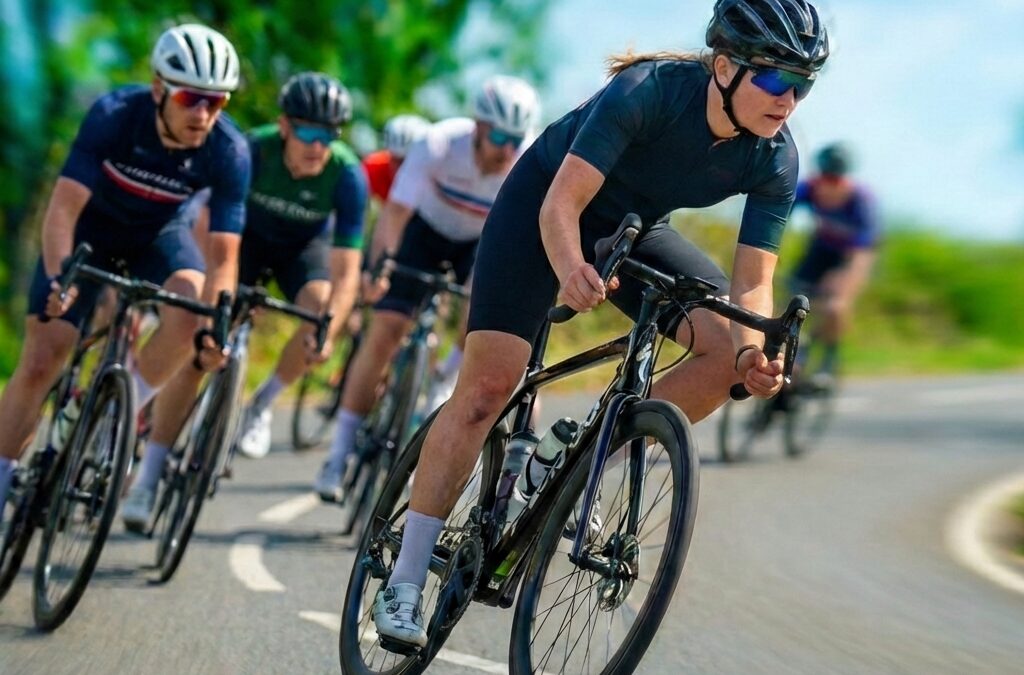
The most dangerous thing a cyclist or triathlete can carry isn’t a lack of fitness, its the pride that prevents them from being a beginner. Many athletes feel embarrassed about being a beginner, but admitting you are a novice is actually the first step to mastery. This is your beginner’s advantage.
We’ve all been there – clipping in at the start of a group ride, feeling that knot in our stomach, hoping nobody notices we’re nervous about that first stop or high-speed descent. That anxiety isn’t a lack of talent, its about learning new skills. There are always new ways to improve your fitness, refine your technique, better understand your equipment, or feel more confident in different environments—on the road, on the trail, in a bunch, or on race day.
Despite years of experience in cycling and triathlon, there are still moments when I feel like a beginner. Not because I’m doing something wrong, but because I an commited to continual learning. And that’s actually part of the appeal.
The Learning Curve Is Steep — and That’s Normal
When you first start, the list of things to learn can feel endless.
For cyclists, this often includes:
- Getting comfortable on the bike
- Riding in a group
- Cornering, descending, climbing, and gearing
- Understanding drafting, bunch etiquette, and events
For triathletes, the challenge can feel even bigger because you are learning three sports at once:
- Open water swimming and sighting
- Riding confidently on open roads or in groups
- Transitions, pacing, and managing fatigue across disciplines
It’s completely normal to feel overwhelmed at times. Feeling like a beginner doesn’t mean you lack ability—it means you’re learning skills in technically demanding sports.
Research in motor learning shows that acquiring new physical skills often involves periods of discomfort and frustration before improvement occurs. This is a normal and necessary part of the learning process, not a sign of failure (Schmidt & Lee, 2019).
Overcoming the Beginner Mindset
Many cyclists and triathletes believe they should feel more confident by now—especially if they’ve been training or racing for a few years.
But feelings of uncertainty, anxiety, or frustration often show up when you’re stepping outside your comfort zone. And that’s exactly where growth happens.
Research on Growth Mindset, developed by psychologist Carol Dweck, shows that people are more likely to persist, adapt, and stay motivated when they believe skills can be developed through effort and learning (Dweck, 2006; Weber, 2018).
Without those “beginner moments”—the awkward ones, the uncomfortable ones—we’d never develop better technique, confidence, or resilience. Feeling like a beginner is often a sign that you’re learning something new, not that you’re doing something wrong.
Progress Comes From Practice, Not Perfection
There is rarely a magic formula for success in cycling or triathlon. Progress usually comes from Deliberate Practice—intentionally working on the areas you find challenging.
- If climbing isn’t your strength, spending time on climbs helps your body adapt.
- If descending or cornering feels uncomfortable, practicing the right techniques in a supportive environment builds trust.
- If open water swimming feels stressful, repeated exposure makes the difference.
Research on deliberate practice shows that targeted, focused practice is one of the most effective ways to build skill and confidence over time (Ericsson et al., 2020). Over time, the things that once felt difficult begin to feel more natural—and the “beginner” feeling slowly fades.
You’re Exactly Where You Need to Be
If you sometimes feel like you still have a lot to learn, that doesn’t mean you’re behind. It means you’re engaged, curious, and developing—exactly what strong cyclists and triathletes do over time.
Neither cycling nor triathlon is about reaching a point where you know everything. They’re about continually learning, adapting, and building confidence across changing conditions. That’s how capable, confident endurance athletes are made.
How to Fast-Track Your Confidence
If you are nodding along to this and feeling that “beginner anxiety” right now, the last thing you should do is wait another year to fit it. Time is the only resource we can’t buy back.
While the group Skills Lab is fully booked and closed for the 2026 season, your progess shouldn’t have to stall just because a program is closed. For athletes who want to compress their learning cureve and bypass the frustration of trial-and-error, I’ve opened a limited number of spots for 1:1 Coaching.
This isn’t just a training plan. It is a high-erformance partnership. Together we will: where we:
- Identify the specific technical gaps slowing you down.
- Build a custom roadmap to build your confidence on the bike or in the water.
- Apply these “deliberate practice” principles directly to your specific goals.
Let’s See If We’re a Fit
I offer a complimentary Skill & Confidence Strategy Call for athletes who are tired of ‘just getting by’ and are ready to mast their craft and fitness..
In this chat, we won’t just talk about “signing up.” We’re going to do three specific things:
- The Diagnostic: Pinpoint the exact the technical ‘leak’ that’s causing your anxiety or holding back your speed.
- The Quick Win: Identify one immediate shift you can make in your next training session to see progress.
- The Vehicle Check: See if my 1:1 coaching framework is the fast way to get you ready for you next event or goal.
My Promise: If I can help you, I’ll show you exactly how. If I’m not the right coach for your specific goal, I’ll point you in the right direction. No pressure, just a clear path forward.
References
Weber, M. (2018, March 15).
Mindset and motivation. Harvard Graduate School of Education.
https://www.gse.harvard.edu/ideas/edcast/18/03/mindset-and-motivation
Ericsson, K. A., Krampe, R. T., & Tesch-Römer, C. (2020). The role of deliberate practice in the acquisition of expert performance. Psychological Review, 100(3), 363–406. https://pubmed.ncbi.nlm.nih.gov/31718526/https://pubmed.ncbi.nlm.nih.gov/31718526/
Schmidt, R. A., & Lee, T. D. (2019). Motor learning and performance: From principles to application (6th ed.). Human Kinetics. https://www.sciencedirect.com/topics/psychology/motor-learning
Weber, M. (2018, March 15). Mindset and motivation. Harvard Graduate School of Education.https://www.gse.harvard.edu/ideas/edcast/18/03/mindset-and-motivation