
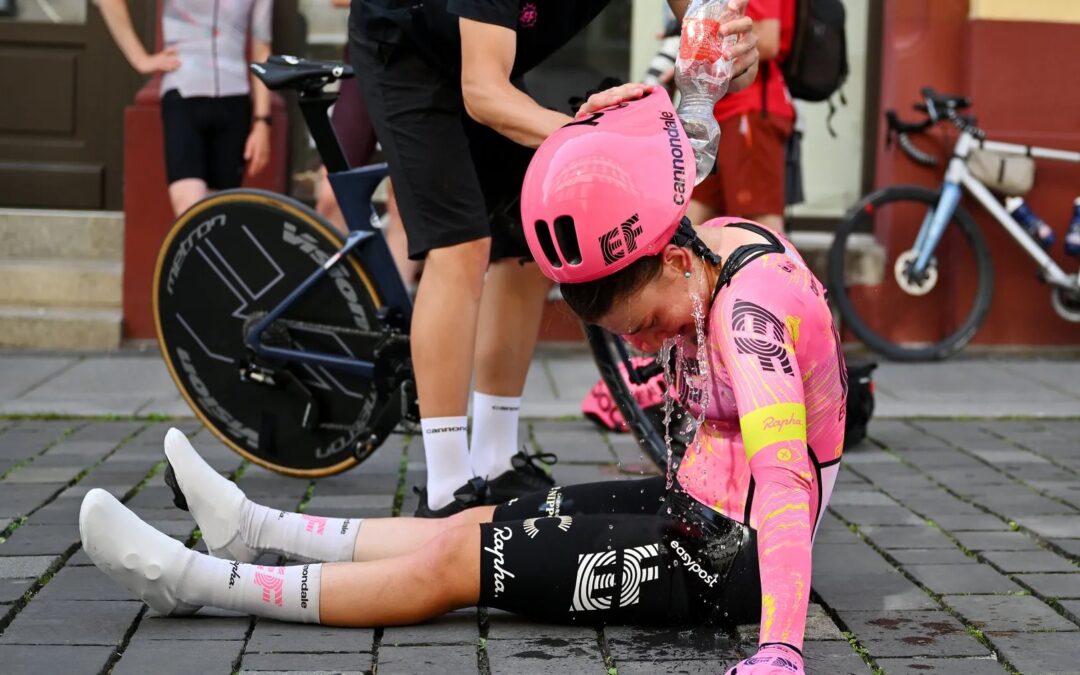
Training through an Australian summer is no joke — especially here in Canberra and Southern Australia, where temperatures soar, humidity swings wildly, and race season hits full speed.
If you’ve ever ridden or raced in 35–40°C conditions, you’ll know exactly what I mean: the heat starts to feel personal.
And if you haven’t experienced true “cooked” legs yet… trust me, it’s coming.
But here’s the good news:
Heat doesn’t have to control your performance.
You can train for it, adapt to it, and turn it into an advantage.
Once you understand how your body responds to heat — and how to work with it rather than fight against it — your summer training becomes safer, smarter, and significantly more productive.
Before we dive in, if you missed my previous article:
👉 Think You’re Hydrated? The Surprising Truth About Sweat and Salt today’s article builds on that. Hydration + heat adaptation go hand in hand.
Why Heat Hurts Performance (And Why Most Athletes Underestimate It)
Most riders and triathletes assume summer training is just “harder because it’s hot.”
But the real WHY is this:
Heat changes the way your body performs, recovers, hydrates, and even thinks.
If you don’t adapt to it, you work harder… for less return.
If you do adapt, you unlock one of the biggest performance advantages available.
This is not guesswork — it’s one of the most consistent findings in endurance research.
1. Your core temperature rises faster than you think
In hot conditions, your body shifts its priority from performance to cooling — long before you consciously feel it.
Research shows that heat and humidity significantly impair endurance performance by increasing cardiovascular strain and perceived exertion (Armstrong et al., 2015).
This is why:
- heart rate drifts upward
- power becomes harder to produce
- your legs feel heavy
- sessions that should feel manageable suddenly feel impossible
Your body is protecting you — but it’s also limiting you.
2. Your sweat rate spikes — and so do your sodium losses
Summer doesn’t just make you sweat more.
It changes what you lose, how fast you lose it, and how your body cools itself.
Many athletes lose 1–3 litres per hour, with huge sodium variation depending on physiology and environment. This is where your heat strategy intersects with hydration — and why your sweat/salt plan needs to match the conditions.
If you haven’t read your hydration deep-dive yet, you can find it here: Think You’re Hydrated? The Surprising Truth About Sweat and Salt.
3. Heat changes how your body allocates energy
When your body is fighting to cool itself, less energy is available for performance.
More blood goes to your skin for cooling.
Less goes to your working muscles.
It’s the classic “I’m fit… but today I feel terrible” that so many age-groupers experience in January.
The Good News: Heat Adaptation Is Real — And It Works
Your body can train for heat just like it trains for aerobic fitness.
And the adaptations are powerful.
Here’s what actually changes:
1. Lowers your core temperature
Heat-adapted athletes can start sweating earlier and more efficiently (Sawka et al., 2011).
2. Reduces heart rate at the same workload
Meaning: the same power output feels easier (Lorenzo & Minson, 2010).
3. Expands your blood plasma volume
More blood = better cooling + better oxygen delivery.
4. Improves endurance performance in hot conditions
Heat-adapted athletes outperform non-adapted athletes, even at identical fitness levels (Périard et al., 2024).
5. Improves pacing, focus, and resilience under heat stress
This is why you’ll see one athlete melts at 38°C…
and another surge.
They’re not “tougher.”
They’re adapted.
But There’s a Catch: Heat Adaptation Must Be Done Properly
Most athletes think “training in summer = heat adaptation.”
It doesn’t.
Unstructured heat exposure can actually reduce training quality and increase heat illness risk, especially when intensity and hydration aren’t aligned (Gibson et al., 2020).
True heat adaptation requires:
- Gradual, repeated exposure
- 7–14 days of consistent heat stimulus
- Controlled session design
- Hydration matched to conditions
- Structured recovery
- Awareness of red flags
You’ll learn exactly how to structure this in Part 2.
My Turning Point: The 40°C ‘Super Criterium’ in Melbourne
My wake-up moment came a few years ago in Melbourne — a summer ‘super criterium’ in 40 °C heat.
One hour.
A sprint prime every lap (every ~ 1km).
Black Tarmac.Zero shade.
Every lap, I aimed for the spray tent — desperate for a few seconds of cooling. But by the time I hit the next corner, the mist had already evaporated.
My legs felt cooked. My lungs burned from the hot air and relentless pace.
And honestly, the only thing that saved me post-race was a frozen slushy someone shoved into my hand.
That day taught me something I have never forgotten:
Heat isn’t just another variable — it’s a performance multiplier.
Ignoring it is optional.
Preparing for it isn’t.
Why This Matters for You
Whether you’re preparing for:
- Husky Tri
- Local crits
- Canberra multisport events
- Or simply navigating summer sessions…
Heat will shape your performance whether you prepare for it or not.
Adapting to heat is the difference between:
🚫 Surviving summer sessions
and
✅ Performing with purpose
If you can adapt to the heat, everything improves:
- pacing
- focus
- recovery
- confidence heading into race day
Coming Next: Part 2 — How to Build Your Heat Adaptation Plan
In Part 2, we’ll cover:
- A practical 7–14 day heat acclimation block
- Indoor vs outdoor strategies
- How to combine heat adaptation with your normal training
- Cooling and hydration tools
- Red flags to watch for
- A real-world example from my coaching
References
Armstrong LE, Casa DJ, Millard-Stafford M, et al. “Exertional Heat Illness during Training and Competition.”British Journal of Sports Medicine, 49(18), 2015.
https://bjsm.bmj.com/content/49/18/1164
Sawka MN, Leon LR, Montain SJ, et al. “Heat Acclimatization to Improve Athletic Performance in Warm–Hot Environments.” GSSI Sports Science Exchange, 2011.
https://www.gssiweb.org/sports-science-exchange/article/sse-153-heat-acclimatization-to-improve-athletic-performance-in-warm-hot-environments
Lorenzo S, Minson CT. “Heat acclimation improves aerobic exercise performance.” Journal of Applied Physiology, 109(4), 2010.
https://pmc.ncbi.nlm.nih.gov/articles/PMC2963322/
Périard JD, Nichols D, Travers G, et al. “Impact of Exercise Heat Acclimation on Performance in Hot, Cool and Hypoxic Conditions.” Journal of Science in Sport & Exercise, 2024.
https://researchsystem.canberra.edu.au/ws/portalfiles/portal/99925672/s42978-024-00300-0.pdf
Gibson OR, Mee JA, Tuttle JA, et al. “Heat alleviation strategies for athletic performance.” Journal of Thermal Biology, 93, 2020.
https://www.tandfonline.com/doi/full/10.1080/23328940.2019.1666624